A lot of people feel that credits disappear after only a few messages. That usually is not because the latest sentence was long. It is because each send repackages everything that came before it and sends that to the model again.
Credits are settled from the tokens used on that turn. Cutting context you do not need is how you spend fewer credits.
How token use actually works
In a single chat, a new message is not billed as only the words you just typed.
To keep the thread coherent, the product sends your earlier messages, the system prompt, and the model's previous replies together with the new message.
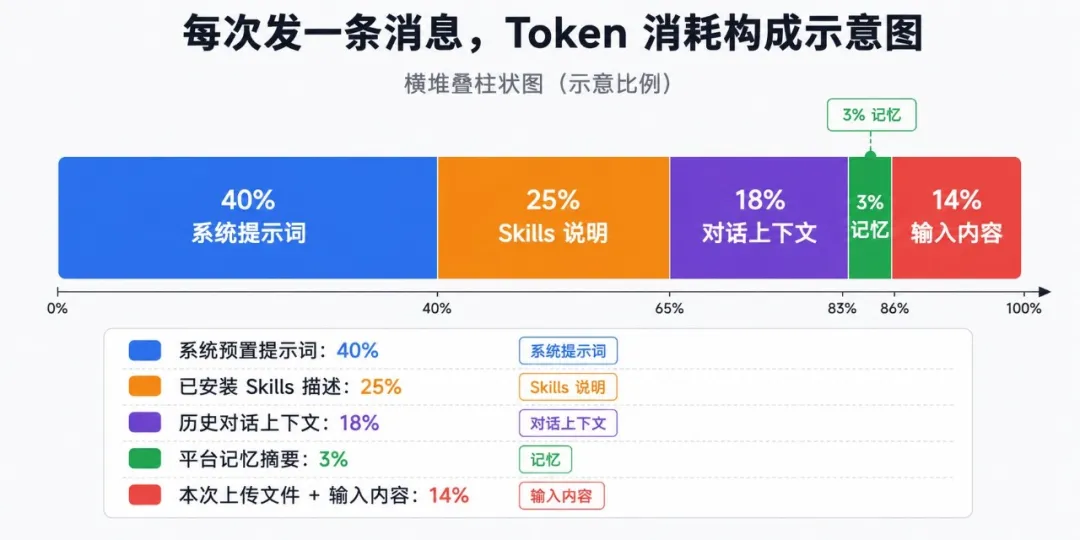
The chart above is only a sketch. A typical send is dominated by the system prompt and installed skill instructions, then prior chat, with the text you just typed as a smaller slice. The longer the thread, the more each later question costs. Credits follow that curve.
Six ways to spend fewer credits
1. Start a new chat when the task changes
When a task is done, or the topic has moved on, start a new chat. Do not keep one window open forever. Otherwise every question pays for history that no longer matters.
2. Shorten the prompt, and remove skills you do not use
- Skip filler such as "Hello, I was wondering if you could..."
- Cut repeated or empty instructions from the prompt.
- If many skills are enabled, turn off the ones you are not using. Their instructions are sent with every request.

One person reported that deleting twelve unused skills cut token use by about sixty percent. A lot of what those skills describe is already something current models do on their own. Extra skills often add tokens without adding capability.
3. Reopen a task if the chat has been idle for a long time
Provider context caches usually last somewhere between a few minutes and about two hours. When a request hits the cache, that cached input costs roughly a tenth of an uncached read. After the cache expires, the full input is priced again.
If a chat has been sitting for a long time, and the old context is no longer what you are working on, a new chat is usually cheaper and easier to follow.
4. For real tasks, say the whole request once
Task work burns more context than casual chat. Put the requirements, constraints, and expected result in one message, and let the model finish in one pass. That is usually cheaper than several rounds of revision.
5. Match the model to the task
Use a lighter model for simple work, such as DeepSeek V3.2, Gemini 3.8 Flash, or DeepSeek V4.1 Flash. For document work or data analysis, DeepSeek V4 Pro or Claude Sonnet 5 is enough for most jobs. Save flagship models such as GPT-5.6 Sol or Claude Opus 5.5 for hard programming or math.
Not every task needs the strongest model. Rewriting and format conversion fit a light model. Document analysis and data processing fit a mid-tier model. Heavy reasoning and complex code generation are what flagship models are for. Splitting work this way saves a meaningful amount of credits. The model list and credit multipliers in the product are the ones that count.
6. Limit how long the answer is
Tokens are split into input and output, and output is usually priced higher. The model's reply is also sent again on every later turn. You can cap the answer in the prompt:
- Ask for a short answer, a bullet list, or a limit such as 200 words.
- If you only need code, ask for the changed code block and no explanation.
Summary
Saving credits is not about making the product worse to use. It is about not paying for context you do not need: start a new chat when the topic changes, do not leave unused skills on, pick a lighter model for simple work, and keep answers short.